
An AI creative system gives a marketing team a shared way to use AI: the brand context that goes in, the decisions people own, the work that comes out, and the evidence used to improve it. Buying access to a tool does not establish those connections.
One person may use AI to draft copy, another to explore imagery, and another to adapt a campaign. Each can save time while the combined work becomes less coherent. The useful question is whether the team can repeatedly produce work that is accurate, distinctive and ready to use.
Start with one recurring job
Choose a workflow with a defined audience, a recognizable bottleneck and a clear owner. Adapting an approved campaign into social posts is a more manageable pilot than asking AI to transform the entire marketing department. Document the current process before changing it.
Record the time spent briefing, making, reviewing and correcting the work. Identify which decisions require product knowledge, audience understanding or creative judgment. Automating the first draft may add little value if the team then spends longer repairing it.
Give the system usable brand context
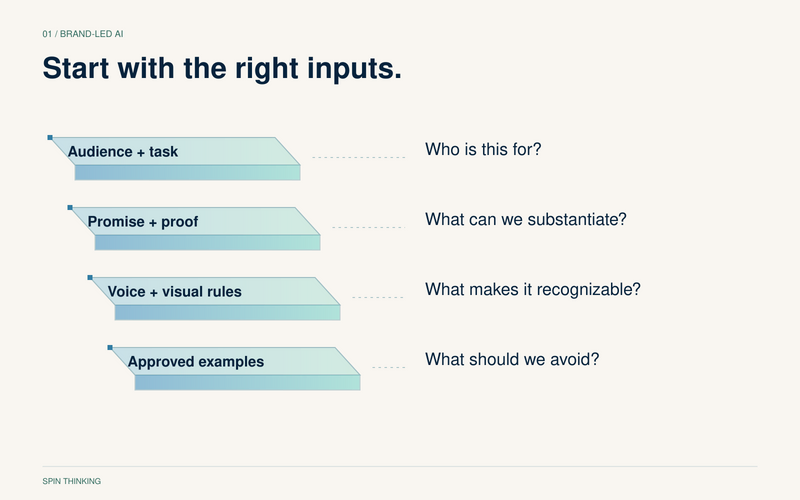
A brand guide is a starting point. Add the information someone needs for this assignment: the intended audience, central promise, approved evidence, tone, visual principles, examples and limits. Separate established facts from ideas the team is still exploring.
For a campaign adaptation pilot, a useful input set contains the approved concept, source copy, claims and their evidence, channel requirements, representative creative, and examples of what would change the meaning. Keep this material versioned so people know which direction is current.
Our message house template can help organize the promise and supporting proof. The AI workflow then needs to explain how that guidance becomes a specific piece of work.
Name the decisions that stay with people
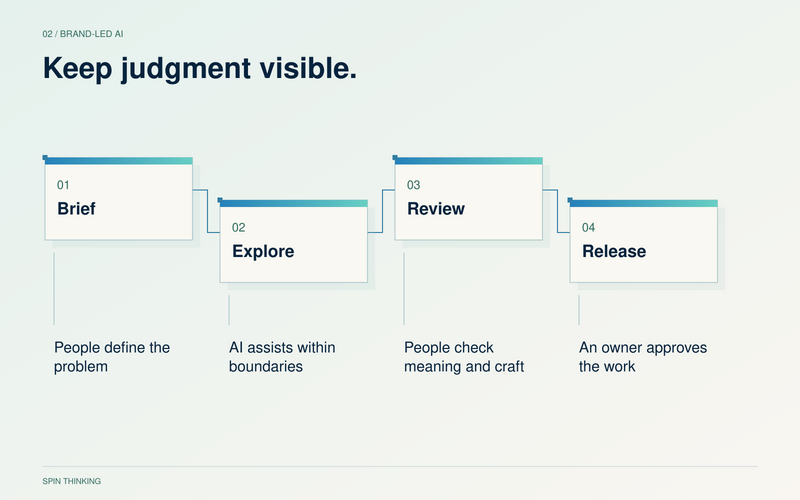
Decide who approves the brief, who evaluates the creative, who verifies claims and who releases the final work. These responsibilities may sit with a small team, but they should be explicit. A final approval box cannot compensate for an unclear brief.
AI can help explore or adapt material within agreed boundaries. A person still needs to judge whether an idea is relevant, whether a visual implies something the product cannot do, and whether the result feels like the brand. Product accuracy and creative quality are separate checks.
Use only tools and inputs approved for the intended work. Follow your organization’s rules for client material, personal information, licensing and disclosure. Where an asset’s permission or factual basis is unresolved, hold that asset until the responsible person resolves it.
Pilot the whole workflow, including the cleanup
Imagine an enterprise team adapting one approved launch idea for three audiences. Keep the underlying promise and evidence fixed. Explore language and composition for each audience, review the options against the brief, then produce only the approved versions. This is an illustrative pilot, not a claim about a client implementation.
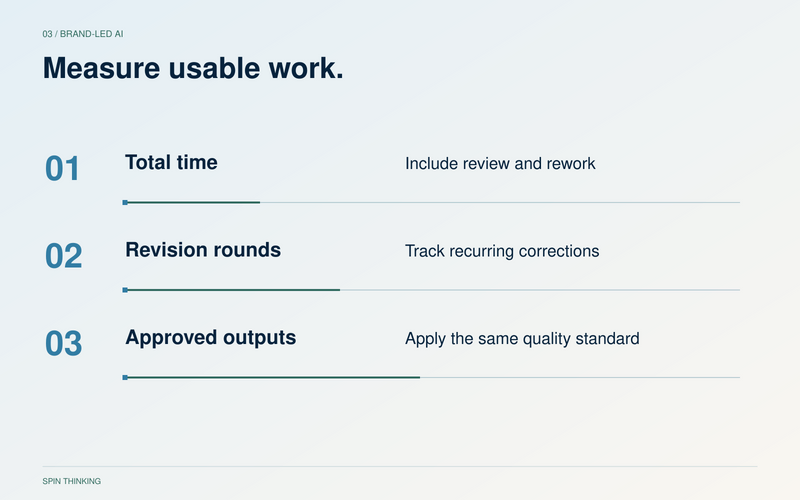
Compare the pilot with the previous process using the same scope and quality standard. Track total time to approval, correction rounds, usable outputs and recurring failures. Include review and rework in the calculation. Faster generation matters only if it helps the team reach a usable result.
Build on what the pilot teaches you
Document why an output succeeded or failed. If reviewers repeatedly reject the same language, revise the guidance. If a tool invents product behavior, tighten the inputs and verification step. If every output is technically acceptable but interchangeable, revisit the creative direction.
Scale only after the team can repeat the process with confidence. Keep space for assignments that need a different approach. A system should make routine choices easier while leaving experienced people room to recognize when the brief calls for something new.
Where a creative partner helps
An outside partner can help define the creative standard, build examples, challenge predictable output and connect strategy with production. The value is judgment throughout the workflow, alongside the practical skills to make the work. See how Spin approaches AI and creative production and embedded creative partnerships.
Does this require a new technology platform?
Not necessarily. Begin with a shared brief, approved inputs, named reviewers and a documented process. Add tooling when it solves a demonstrated workflow problem.
What should the first success measure be?
Choose a measure tied to the pilot’s problem, such as less total time to an approved campaign adaptation. Pair efficiency with a quality check so speed does not conceal extra correction work.