

A photo library can contain hundreds of good images and still leave a design team without the right one. The subjects are attractive, the exposures are consistent, and the files are organized. Yet none leaves room for the headline, shows the relevant interaction or belongs naturally beside the brand’s typography.
Spin’s view: commission the point of view before you commission the volume. Enterprise brand photography needs a direction that connects what the business wants to communicate with what people actually see. A useful library gives teams a considered range of choices, each made for a job.
Start with the placements that are hardest to solve
Inventory the real requirements: website openings, product pages, sales presentations, campaign placements and recruiting communications. Identify where the current library fails. A desktop banner, a narrow mobile crop and a presentation slide place different demands on the same subject.
Choose a few priority uses to test before expanding the shot list. Sketch the layout with its intended words, image area and crop. Decide whether one photograph can serve the placements well or whether you need distinct compositions. Stretching one hero image across every format can create a library that is technically adaptable and editorially weak.
The wider brand system supplies context: what should the imagery help the audience understand, and how should it feel beside the identity? A photography brief turns that direction into choices about subjects, environments, light and framing.
Ellevation: put the brand’s purpose in front of the camera
For Ellevation’s website and marketing photography, Spin planned classroom scenes and individual portraits alongside the website redesign. The assignment connected students, teachers and learning interactions to a considered brand experience. Miguel Cornelio photographed the work, with Spin leading art direction and production.

Wardrobe, props, classroom settings and portrait backgrounds were considered in relation to the identity’s color, type and graphic elements. That is a practical meaning of art direction: choices made before the shutter so the finished images have a place in the design.
These scenes were planned and directed. Present them as brand photography, with accurate context, rather than implying that every interaction was captured as an unobserved documentary moment. The work demonstrates a visual approach and production scope; it does not establish a measured marketing outcome.

Test the direction as a small working library
Test the library in use.
Does this image communicate something specific to the brand?
Does the intended layout keep the subject and message clear?
Do the images offer useful variety within one point of view?
Can the next team find, understand and use the right selection?
A pilot is useful when it resolves a real uncertainty. Test the proposed direction in the difficult placements, using actual copy and realistic crops. Include enough range to judge the idea: an environmental view, an interaction and a closer detail might serve one brief. Another may need portraits and product-use scenes.
Review what holds and what needs to change. Does the image say something specific? Are the people central to the story? Does the mobile crop retain the important action? Can the image work beside the brand’s graphic system without extensive repair? Expand the production after those questions have useful answers.
Amazon: make room for individual character
In Spin’s Amazon marketing photography, environmental portraits and workplace interactions support recruitment and digital marketing. The stills were planned alongside video, with dedicated compositions and direction. Miguel Cornelio photographed the assignments, while Spin coordinated the creative and production process.

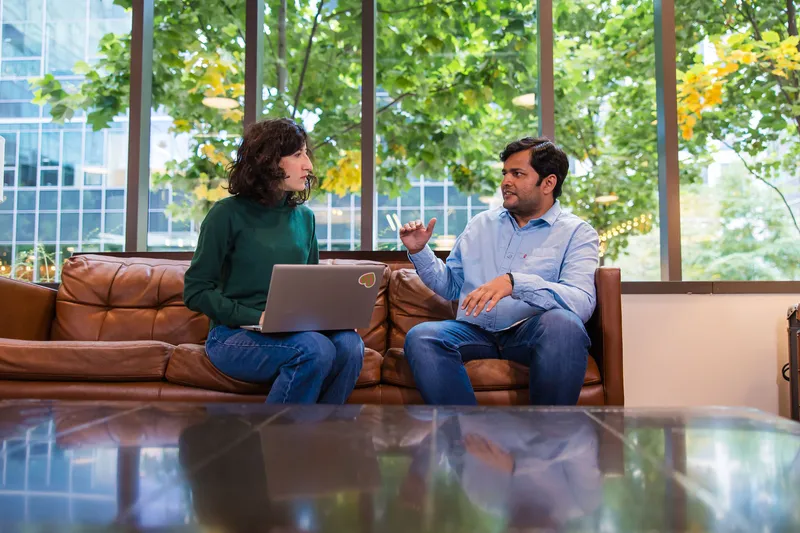

The work offers a useful distinction between consistency and sameness. Light, environment and direction can connect a library while people retain their own presence. Repeating one pose or one crop is a narrow substitute for a shared point of view.
Amazon reviewed a curated selection; finishing included exposure adjustments, cleanup of distracting signs and stickers, and keyword tags. Selection and delivery are part of making a library usable. The handoff needs the same intention as the shoot.
Write rules that preserve judgment
Document what future makers need to understand: the role of people and place, the desired emotional register, lighting references, composition principles, retouching boundaries and examples of successful crops. Show the reasons behind the choices. A list of camera settings cannot reproduce an editorial judgment on its own.
Separate the essentials from the flexible elements. The subject may need to remain visible with adjacent copy, while camera distance can vary. The grade may need a consistent character, while natural light changes by location. A good system helps another photographer interpret the brief in a new setting.
Our discussion of creative direction and art direction can help define who owns the communication idea and who translates it into the image. Agree those responsibilities before production.
Budget for the image’s whole working life
Ask for a scope covering creative development, planning, participants, locations, shoot time, selection, finishing, delivery formats and agreed usage. Establish the intended channels, regions and duration with the responsible rights and legal reviewers. Record applicable permissions and restrictions where future users can find them.
A larger capture count is not automatically more value. Compare proposals on the approved images and uses they will deliver, the creative attention each setup needs and the work required after the shoot. A focused library that answers priority needs may be a better first investment than a broad library with no agreed applications.
Make the handoff easy to use and maintain
Deliver clearly named approved masters and appropriate channel derivatives. Keep useful metadata with each selection: subject, project, intended uses, rights reference, review owner and any relevant restrictions. Include crop guidance, image descriptions and examples in real layouts.
Assign an owner for additions and retirement. Revisit images when people, products or brand context change. Capture requests from designers and regional teams so the next shoot fills a demonstrated gap. This gives the program a learning loop grounded in actual use.
How do we know the library is helping?
Start with practical evidence: whether priority placements are covered, whether teams can find and use approved images, and where new requests still arise. If testing a campaign image, define a controlled comparison and an appropriate sample with your analytics team. Treat any observed result as evidence within that test’s limits.
Explore Design and Spin’s photography work, or start a conversation with your hardest-to-fill layout. It is a useful place to begin building an image library with a point of view.