

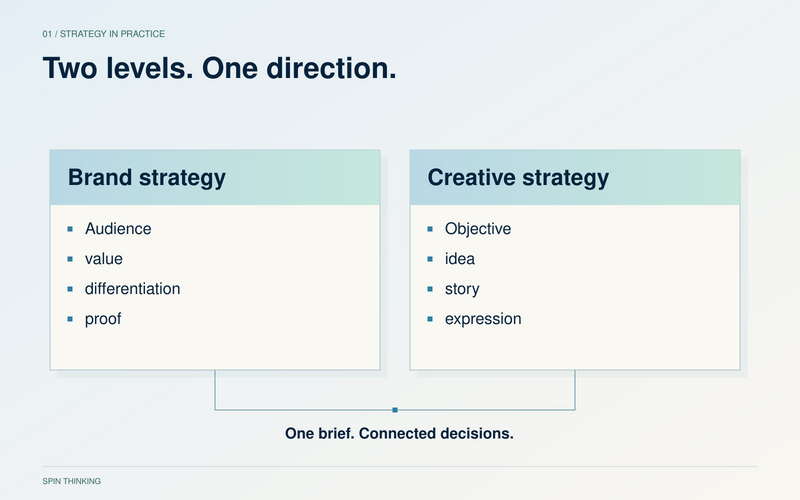
Brand strategy defines the relevant value a business wants to stand for and the people it serves. Creative strategy determines how to express that value through a particular campaign, story or experience. They work at different levels, but neither is useful in isolation.
For a marketing leader, the distinction helps locate the decision that is missing. Are people still debating why buyers should choose the company? Or is that direction settled while the next campaign lacks a compelling idea? Those are different assignments.
Brand strategy sets the direction
Brand strategy brings together audience understanding, competitive context, positioning and the evidence behind the promise. It should help a team explain what the business offers, why that matters, and where it can credibly stand apart.
The output should guide decisions beyond a single launch. If the company introduces another product or enters a new market, the team needs to know which parts of the brand remain consistent and which need to evolve. A positioning statement earns its value by helping people make those choices.
Creative strategy makes that direction specific
Creative strategy turns the brand direction and a current business objective into an assignment people can make. It identifies the audience tension, the idea, the evidence, the viewing context and the response the work should invite.
The expression can change across a film, a website and a sales presentation. The work should still carry a recognizable promise. Repeating one headline everywhere is not the same as building a coherent campaign.
A practical example
Imagine a software company whose buyers struggle to find approved campaign assets. Its proposed brand position is built around reliable access to the right material. Before using that position, the team needs evidence that the product can deliver it and that the problem matters to buyers.
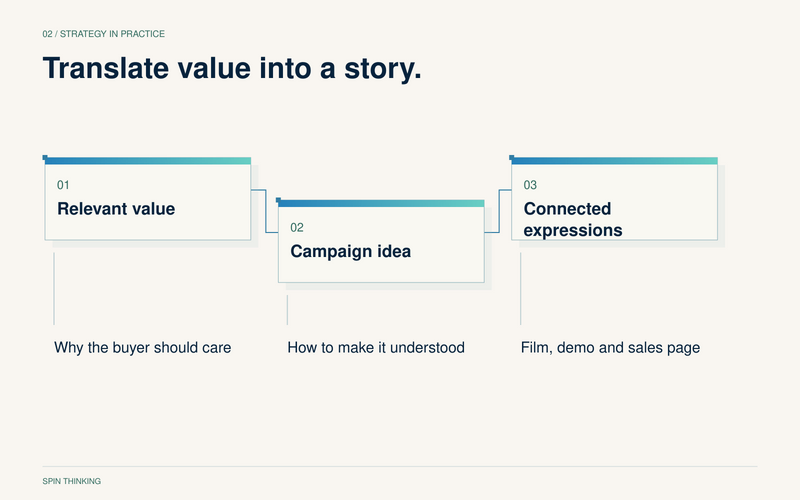
A launch campaign could then dramatize the moment a team stops chasing approvals and starts creating. A short film establishes that change; a product demo shows how the workflow operates; a sales page answers questions about access and control. This is a hypothetical example, not a Spin client claim.
The brand strategy establishes the relevant value. The creative strategy chooses how to make that value understood in this situation. If the underlying product promise is weak, a striking campaign cannot repair it.
Use the disagreement to diagnose the brief
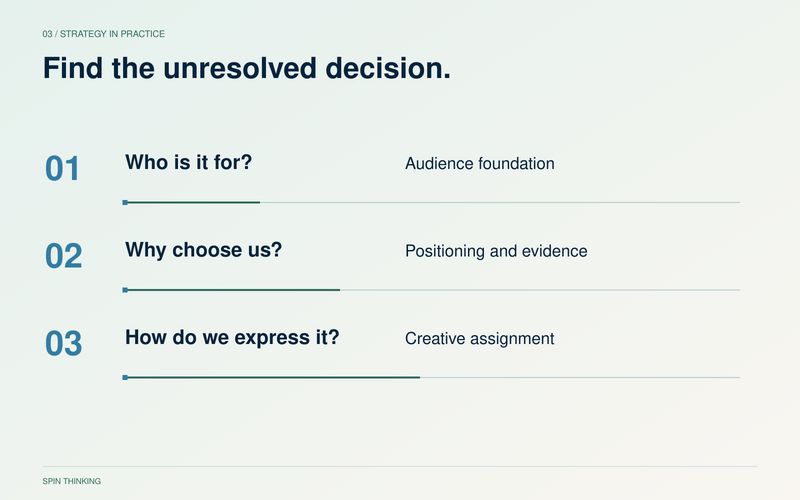
When stakeholders cannot agree on the audience, differentiation or reason to believe, revisit the brand foundation. When they agree on those things but disagree about the concept, tone or channel expression, focus the creative assignment.
Sometimes the problem crosses both levels. Research for a campaign may reveal that the positioning is no longer credible. Treat that as a reason to revisit an assumption, rather than quietly changing the brand through a series of unrelated executions.
Make the handoff useful
Give the creative team the audience, business objective, central promise, supporting evidence and genuine constraints. Explain the reasoning behind the direction. Distinguish what is decided from what the team is expected to explore.
A message house can organize the communication. Creative direction and art direction then guide the idea and its visual expression. These are connected responsibilities, not interchangeable documents or job titles.
At Spin, we connect the foundation to the work through brand systems, design, motion and production. The aim is a direction strong enough to guide the next assignment and flexible enough to produce something distinctive.
Which should come first?
Establish enough brand direction to brief the creative work clearly. That does not mean every brand question must be resolved forever. It means the team should understand the assumptions it is working from.
When should the strategy change?
Revisit it when evidence changes: a new audience, a different offer, a competitive shift or a persistent gap between the promise and customer experience. A fixed calendar alone is not a sufficient reason to rebrand.