

A brand audit can make inconsistency visible without making the next decision any easier. The website looks one way, the sales deck tells another story, and the product team has its own vocabulary. Putting those differences in a presentation is useful. Deciding which ones matter is the strategic work.
At Spin, we think an audit should end with a choice the organization can act on: what to keep, what to repair, what to replace and what still needs evidence. For enterprise brand and marketing leaders, that turns an inventory into a brief for the next investment.
Name the decision before collecting the assets
Start with the business question. Are buyers misunderstanding the relationship between your products? Has an acquisition made the portfolio difficult to explain? Does the identity support the audiences and channels the business now serves? Each question calls for a different sample of materials and a different kind of research.
Agree who will use the findings, what they need to decide and when. Define the audiences, markets, products and touchpoints in scope. A bounded audit can answer a meaningful question without pretending to describe the entire organization.
Keep the audit separate from a preselected solution. If the brief already assumes a new identity, the review can become a justification exercise. Leave room for a finding that the existing identity works and the real problem lies in messaging, applications or ownership.
Compare intent, expression and understanding
Collect the current positioning, messaging and guidelines as evidence of intent. Then examine what people actually encounter: product pages, sales presentations, campaign creative, onboarding material and relevant communications. Include the touchpoints closest to the decision you need to understand.
Finally, investigate what the intended audience takes away. Ask customers, prospects and customer-facing colleagues to describe the offer in their own words. Interviews can reveal reasons and vocabulary; they do not establish how widespread a perception is. A broader research design may be needed when the decision depends on prevalence or comparison between segments.
A message house provides a useful reference for this comparison. Test whether the promise and its supporting evidence survive in the actual materials. A consistent logo cannot compensate for contradictory claims.
Really Great Reading: connect the foundation to its expression
For Really Great Reading’s identity redesign, Spin began with discovery, stakeholder perspectives and competitive context. The work connected strategy and messaging to a visual system organized around expertise and impact. Its brand house brings the promise, proposition, beliefs and audience benefits into one framework.
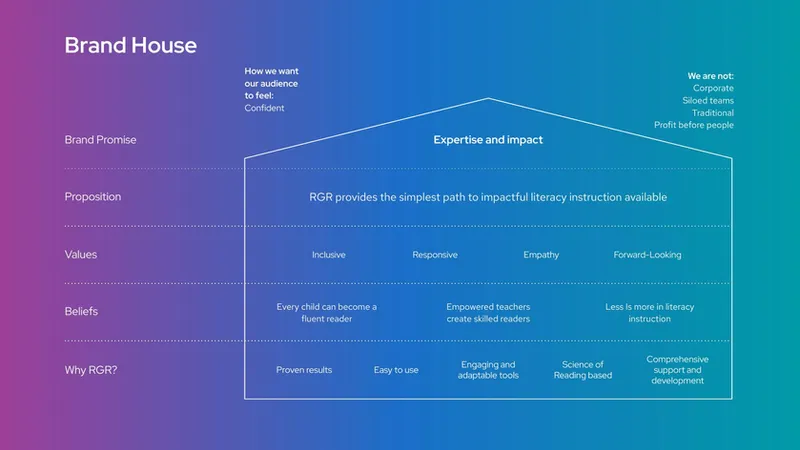
This project illustrates a relationship an audit should examine: can the team trace a design choice or message back to a meaningful strategic foundation? It is a redesign case, not a claim that a particular audit method produced a measured business result.
For your review, keep the chain visible. Record the intended promise, the asset that expresses it, the audience’s interpretation and the evidence supporting your recommendation. Where the chain breaks, identify what you know and what you need to investigate.
Keep the assets that still earn their place
For Ellevation’s brand evolution, the existing brand was recognizable and well loved. Spin retained the logo’s recognizable form, refined its color treatment and developed a more expressive system around it. The Summit graphic grows from the logo’s three bars, rotated and overlapped into mountain peaks.
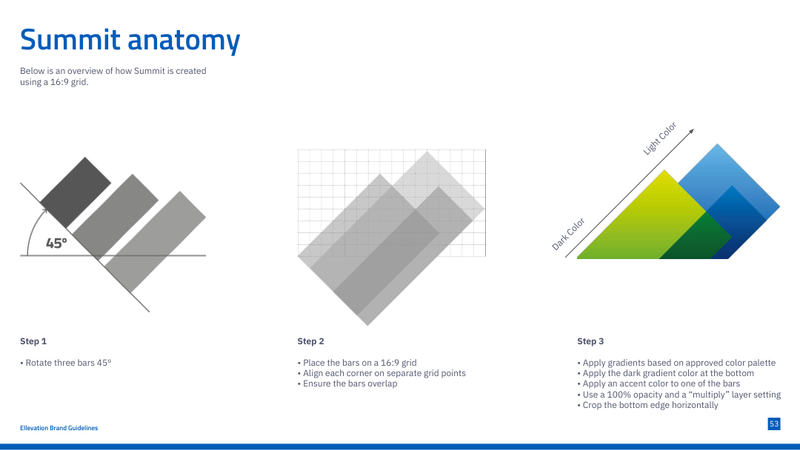
The lesson is selective change. A brand can need more range without needing to abandon every familiar element. Assess recognition, relevance and usability separately. Preserve what has a supported role; develop what the current system cannot yet do.
That distinction helps an enterprise team compare a focused repair with a wider program. Our guide to building brand systems explains how strategic direction connects to practical applications.
Turn each gap into a recommendation
Give every finding a next step.
Evidence supports the asset’s current role. Record why it should stay.
The direction is useful; a specific application or process needs attention.
The observation is real, but the cause or prevalence remains uncertain.
Evidence supports a different direction. Name the decision and its dependencies.
For each finding, name the observation, supporting source, likely consequence, confidence level and decision owner. Distinguish an observed problem from an explanation you have not tested. Three conflicting sales decks are observable. Why they differ may require a conversation with the people who maintain them.
Consider a hypothetical example: regional teams use different product claims because the approved source is difficult to find. Replacing the decks may help immediately. Assigning a messaging owner and maintaining a usable source addresses the condition behind the drift. A new logo would leave that problem unresolved.
Review the conditions that produce the work
Ask how a brief reaches a maker, how approved assets are found, who resolves exceptions and what happens when product information changes. Watch someone complete a real task using the current tools. The gap between a guideline and its everyday use can be more revealing than another page of scores.
Include accessibility and responsive behavior in the application review. Test the actual typography, contrast, image crops and navigation people encounter. Record the affected component and the relevant review owner so a finding can become a specific repair.
Work with analytics and research colleagues to interpret commercial signals. Conversion, retention and sales feedback can help frame a question, but pricing, product experience and market conditions also influence those outcomes. Do not attribute a business change to branding from a correlation alone.
Finish with a decision memo
Give leadership a concise account of the business question, strongest findings, options and recommended next step. Explain what each option preserves, changes and requires. Put the asset inventory and detailed evidence behind the recommendation so the working team can use them.
Prioritize by the importance of the affected audience decision, the strength of the evidence, dependencies and effort. Assign an owner and a way to confirm completion. “Improve consistency” is too broad to approve or verify. “Replace the three conflicting product claims with one reviewed explanation and update the named sales templates” is a workable action.
If the recommendation is a broader rebrand, connect it to the full implementation scope. The Rebrand Budget Is Bigger Than the Identity explains why rollout and adoption belong in that decision.
What should we bring to an audit conversation?
Bring the business question, the current strategy, a few high-value touchpoints and the evidence already available. Identify who can act on the findings. Explore Spin’s Branding capabilities or start a conversation. The useful outcome is a clearer choice about what happens next.