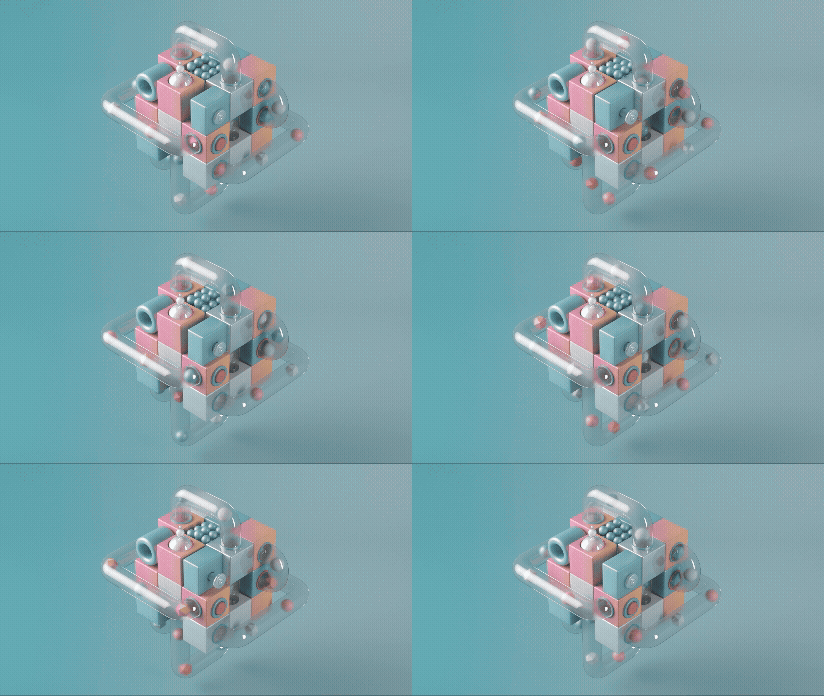
Creating a Brand Motion System for Modern B2B Enterprise Brands
As B2B enterprise brands scale across product marketing, advertising, social content, keynote presentations, web experiences, sales enablement, and AI-generated creative, many teams are running into the same challenge: Their brand moves differently everywhere.

One campaign uses highly polished cinematic animation. Another uses minimal UI motion. Product demos feel disconnected from paid advertising. Social videos look unrelated to keynote visuals. Motion becomes fragmented instead of recognizable.
At Spin Creative, we believe the next evolution of branding is not just visual identity systems. It’s scalable brand motion systems.
And for enterprise organizations moving quickly across channels, this is becoming increasingly important.
What Is a Brand Motion System?
A brand motion system is a strategic framework that defines how a brand behaves in motion across every touchpoint.
It goes beyond animation style guides or isolated video assets.
A true motion system creates consistency in:
- Movement principles
- UI behavior
- Transitions
- Camera language
- Product storytelling
- Timing and pacing
- Attention guidance
- Modular layouts
- Interactive experiences
- Social content systems
- Event visuals
- Advertising executions
The goal is not to make every piece of content look identical.
The goal is to create recognizable behavior and emotional consistency across the entire brand ecosystem.
Why Brand Motion Systems Matter More Now
For years, many B2B brands treated motion as a campaign deliverable rather than a foundational brand system.
That approach no longer scales.
Today’s enterprise marketing teams are producing:
- Product launch videos
- Paid social campaigns
- Customer stories
- Explainer videos
- Event graphics
- Website motion
- Interactive demos
- AI-generated content
- Executive keynote visuals
- Sales enablement content
- Short-form vertical video
Often simultaneously.
Without a motion framework, content starts feeling disconnected, inconsistent, and operationally difficult to scale.
This becomes even more important in the AI era.
As AI tools dramatically increase content velocity, brand consistency becomes harder to maintain. The brands that stand out will not necessarily be the ones producing the most content.
They’ll be the ones building recognizable systems.
The Difference Between Motion Design and a Motion System
Many organizations already create strong motion graphics.
But a motion system is different.
Motion design focuses on creating individual assets.
A motion system focuses on creating repeatable principles that can scale across teams, vendors, campaigns, and platforms.
That includes defining:
- How product UI enters and exits frame
- How attention is guided
- How information transforms
- How layouts respond
- How motion supports clarity
- How product experiences feel emotionally
- How transitions reinforce the brand
- How modular templates operate
In practice, this helps brands create content faster while improving consistency.
What Enterprise Brands Are Really Looking For
Most enterprise marketing leaders are not looking for “more animation.”
They’re looking for:
- Better scalability
- Faster production
- Stronger brand recognition
- Cleaner product storytelling
- More consistency across teams
- Better integration between product and marketing
- Creative systems that support AI workflows
- Motion that feels modern without becoming trendy
This is especially true for SaaS, AI, fintech, cloud, enterprise software, and platform-based brands where product storytelling plays a major role in customer understanding.
The Rise of Product Motion Systems
One of the biggest shifts happening right now is the blending of:
- Brand systems
- Product marketing
- UX motion
- Advertising
- Cinematic storytelling
- Interactive design
The strongest enterprise brands increasingly treat product motion as part of the brand experience itself.
Not separate from it.
This means:
- UI storytelling becomes more intentional
- Product interactions feel elevated
- Motion reinforces usability and comprehension
- Visual systems become more modular
- Content becomes easier to scale globally
Done well, motion becomes a strategic business asset, not just a production layer.
Building a Motion System Starts Small
One misconception is that brands need a massive system upfront.
In reality, the strongest motion systems often begin with:
- 2–3 high-value product moments
- Core movement principles
- Early motion explorations
- Template structures
- UI abstraction rules
- Reusable storytelling patterns
From there, systems evolve over time as teams learn what scales operationally and creatively.
The key is creating a foundation that can grow.
Motion Systems and the Future of AI Content Creation
As AI-generated creative becomes more common, motion systems may become even more important than visual identity systems alone.
Why?
Because AI can generate infinite content variations.
But systems create coherence.
Without strategic motion principles, AI-generated content risks becoming visually inconsistent and emotionally generic.
The future likely belongs to brands that combine:
- Human creative direction
- Strategic motion thinking
- Scalable systems
- Modular workflows
- AI-assisted production
The competitive advantage will not simply be speed.
It will be recognizable creative behavior at scale.
Frequently Asked Questions
What is a brand motion system?
A brand motion system is a strategic framework that defines how a brand behaves in motion across video, product, advertising, web, social, and interactive experiences.
Why are motion systems important for B2B brands?
They help enterprise organizations create scalable, recognizable, and cohesive brand experiences across large volumes of content and multiple teams.
How is a motion system different from motion graphics?
Motion graphics are individual creative executions. A motion system defines repeatable principles and behaviors that scale across campaigns and channels.
What industries benefit most from brand motion systems?
SaaS, AI, fintech, enterprise software, cloud platforms, healthcare technology, and other product-driven B2B brands benefit significantly because product storytelling is central to their marketing.
Can small internal teams use a motion system?
Yes. Motion systems are especially valuable for lean teams because they create consistency and speed while reducing the need to reinvent creative approaches for every project.
About Spin
Spin Creative is a brand storytelling agency specializing in branding, design, motion, and advertising for modern enterprise brands. We help organizations create strategic creative systems that scale across campaigns, product marketing, video, digital experiences, and emerging AI-driven workflows.