How We Made the Skillsoft Percipio Platform Sizzle by Showing Less
There's a specific challenge that comes with marketing sophisticated enterprise platforms: they do a lot, and the people who built them naturally want all of it represented.
The instinct is understandable. When a platform delivers real intelligence, meaningful integrations, and measurable outcomes, it can feel risky to leave anything out. What if buyers miss a critical capability? What if they don't fully understand the value?
But in our experience, the opposite is often true.
The more you try to explain, the less people remember.
That belief became the foundation of the Skillsoft Percipio Platform Sizzle we created as part of Skillsoft's brand refresh. Our goal wasn't to communicate everything the platform could do. It was to create clarity, build intrigue, and make people want to learn more.
Skillsoft Percipio Platform Sizzle
The Problem With Trying to Show Everything
Many enterprise software videos begin with good intentions.
Teams want to communicate the breadth of the platform, reassure stakeholders, and ensure no major capability gets overlooked.
The result is often a rapid-fire sequence of features, workflows, dashboards, and messages compressed into sixty seconds.
Unfortunately, viewers experience this differently.
Instead of clarity, they experience overload.
Instead of confidence, they experience complexity.
A product sizzle has a fundamentally different job than a product demo or technical explainer. Its purpose is not to educate someone on every feature. Its purpose is to create interest and communicate value quickly enough that the audience wants to continue exploring.
Once we aligned on that objective, every creative decision became simpler.
We stopped asking, "What else should we include?"
We started asking, "What is most important to leave behind?"
Designing for Restraint
From the outset, the creative brief emphasized a simple principle:
Restraint over coverage.
Rather than packing the film with dozens of visual ideas, we focused on:
- Fewer scenes
- Longer scene durations
- One primary message per moment
- Minimal on-screen copy
- No voiceover
- Storytelling driven by motion, typography, and music
The decision to remove voiceover was especially important.
Voiceover makes it easy to layer information. You can explain one concept while showing another, allowing complexity to accumulate quickly.
Without narration, every visual moment must stand on its own.
The motion must communicate clearly.
The typography must be purposeful.
The pacing must create understanding rather than simply generate energy.
This constraint forced focus, and that focus ultimately made the story stronger.
Showing AI Without Talking About AI
One of the most interesting challenges involved Percipio's AI capabilities.
The platform uses AI in meaningful ways across skills intelligence, learning recommendations, content organization, talent alignment, and workforce development.
The obvious solution would have been to make AI the headline.
But by 2026, nearly every technology company was claiming to be AI-powered.
The term itself had begun to lose its impact.
Instead of talking about AI, we focused on showing intelligence.
We visualized:
- Skills connecting dynamically across teams
- Relevant insights surfacing automatically
- Learning pathways adapting to needs
- Talent aligning with opportunities
- Systems responding intelligently to change
The audience experiences the benefits without being repeatedly told how those benefits are generated.
The intelligence becomes visible through behavior rather than labels.
As a result, the story feels more timeless, more credible, and more focused on outcomes than technology buzzwords.
Building One Motion Language for the Entire Platform
Complex platforms often introduce another challenge.
Every capability wants its own visual treatment.
One feature gets one style. Another feature gets another. Soon the video becomes a collection of disconnected moments rather than a cohesive platform story.
We deliberately moved in the opposite direction.
The entire film was built around a single motion language.
Connected nodes.
Flowing pathways.
Signals.
Pulses.
Relationships.
Movement with purpose.
Every scene feels like a different perspective on the same living system rather than a new product being introduced.
This consistency reinforces the core strategic message: Percipio isn't a collection of tools. It's a connected platform where skills, learning, talent, and business outcomes continuously inform one another.
Why We Chose 2D and 2.5D Motion Graphics
The medium matters as much as the message.
For this project, we intentionally chose 2D and 2.5D motion graphics over both live action and full 3D animation.
Live Action Creates Unnecessary Specificity
For platform stories, live action often defaults to familiar business imagery:
- People sitting at laptops
- Conference rooms
- Team meetings
- Generic workplace interactions
While relatable, these visuals rarely help explain how a platform works. They can also limit how broadly audiences see themselves in the story.
Full 3D Can Sacrifice Clarity
Full 3D animation can be visually impressive, but complexity is not always an advantage. For a platform film, understanding is more important than spectacle.
2D and 2.5D Offered the Best Balance
Motion graphics allowed us to:
- Simplify complex systems
- Visualize relationships and flow
- Maintain visual clarity
- Move quickly between ideas
- Create reusable design assets beyond a single film
The format supported the story rather than competing with it.
Why We Built the Film Around Music First
Music often arrives late in production.
For this project, it arrived first.
Before animation began, we selected and locked the music track. The structure, pacing, and emotional arc of the film were built around it.
This decision influences far more than mood.
Music determines:
- How long ideas remain on screen
- When transitions occur
- Where momentum builds
- When tension releases
- How the story resolves
When motion is designed around an established rhythm, every movement feels intentional.
The result is a film that feels cohesive because visual storytelling and sound were developed together from the beginning.
The Power of Fewer, Longer Scenes
One of the simplest decisions became one of the most important.
We reduced scene density.
In motion design, there's often a temptation to keep cutting.
New visual.
New message.
New movement.
New transition.
The pace creates the appearance of energy.
But pace without understanding is simply noise.
Instead, we allowed concepts time to develop.
Each scene had enough space to introduce an idea, evolve it visually, and resolve it before moving forward.
The result feels more confident.
And confidence matters.
When products rush, audiences sense uncertainty. When ideas are given room to breathe, audiences sense conviction.
For enterprise brands, that confidence can be more persuasive than any feature list.
Ending With Positioning Instead of Explanation
The film concludes with two simple statements:
From Workforce to Skillforce.
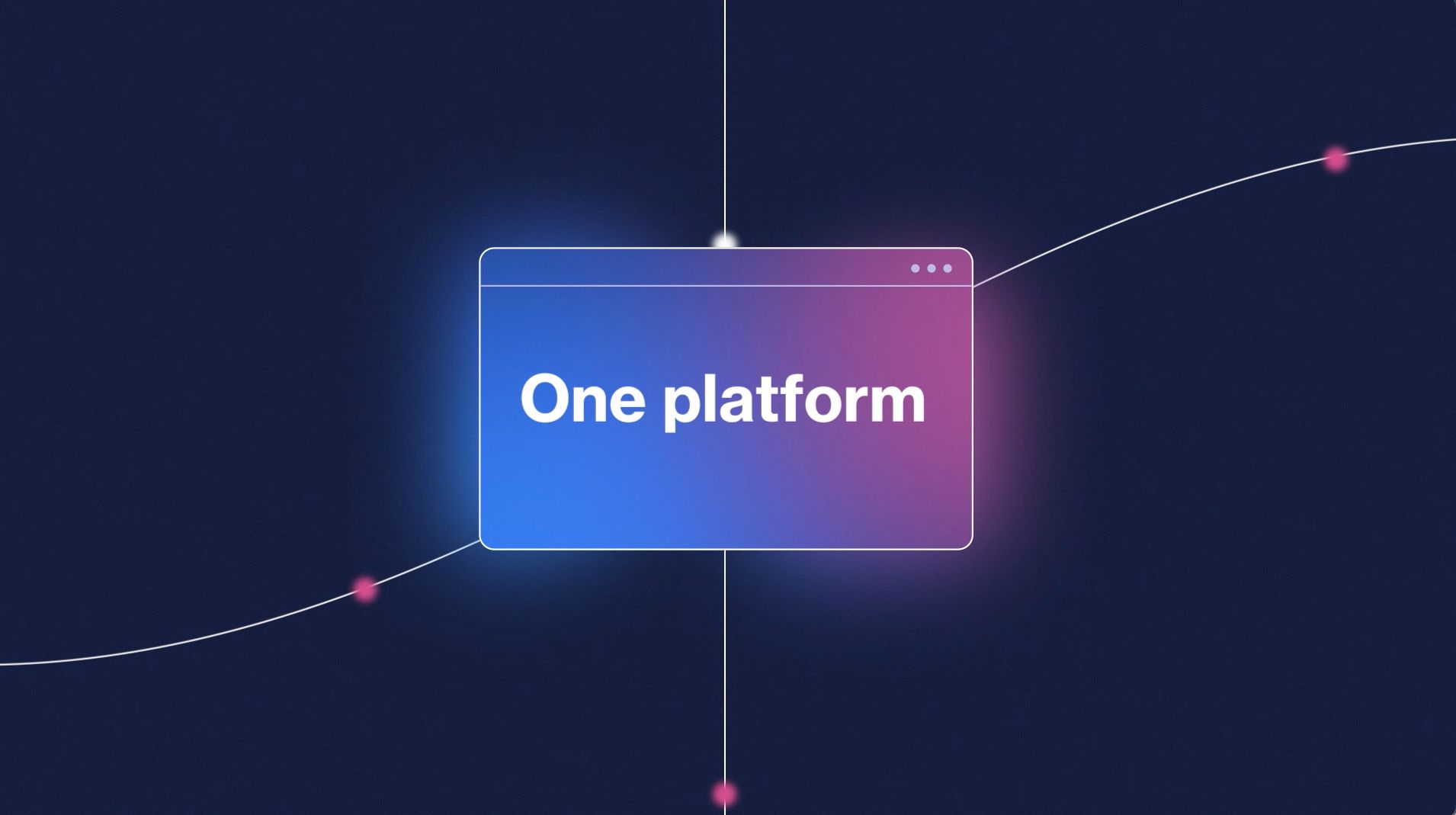
One Platform. Skills That Move Business.
Then the Skillsoft logo.
No recap.
No lengthy call-to-action.
No list of capabilities.
No final explanation.
Just a clear position and a moment of stillness.
After a minute of continuous motion, that pause allows the message to land. The audience is left with a clear impression rather than a crowded memory.
And that was always the goal.
What Enterprise Marketers Can Learn From This Approach
When marketing complex products, the instinct is often to add more.
More features.
More explanations.
More proof points.
More screens.
But effective storytelling frequently requires subtraction.
A few principles worth considering:
Focus on curiosity before comprehension
People need a reason to care before they need every detail.
Prioritize outcomes over capabilities
Show what changes for customers rather than listing functionality.
Build a consistent visual language
Cohesion strengthens both storytelling and brand recognition.
Use motion intentionally
Movement should clarify ideas, not simply create activity.
Trust the audience
You don't need to explain everything to communicate value. Often, the strongest message is the one you choose not to say.
Frequently Asked Questions
What is a product sizzle video?
A product sizzle video is a short marketing film designed to generate interest, communicate positioning, and create excitement around a product or platform. Unlike a demo, its goal is curiosity rather than detailed education.
How long should an enterprise software marketing video be?
Most product sizzle videos perform best between 45 and 90 seconds. The objective is to communicate value quickly while encouraging further exploration.
Should SaaS companies use motion graphics or live action?
It depends on the story. Motion graphics are often more effective for explaining systems, workflows, data relationships, and platform capabilities that are difficult to visualize through live action alone.
How should brands talk about AI in marketing?
Rather than leading with AI claims, many brands benefit from demonstrating intelligent outcomes. Showing the impact of AI is often more persuasive than repeatedly labeling a product as AI-powered.
Why are fewer scenes often more effective?
Longer scenes give audiences time to process information, improve clarity, and create a greater sense of confidence. Excessive cutting can reduce comprehension and weaken the overall message.
About Spin Creative
Spin Creative is a brand storytelling agency specializing in branding, design, advertising, motion graphics, and video storytelling for ambitious B2B and enterprise brands. We help organizations simplify complexity, launch new products, refresh brands, and create motion-led experiences that move audiences across every channel. From brand films and product marketing campaigns to motion systems and launch content, we combine insight-driven strategy with powerful creative execution.