Brand Lift Study: A 2026 Guide for Marketers
A brand lift study measures the incremental effect advertising has on how people perceive a brand. It compares responses from people who were exposed to a campaign with responses from a control group that was not. The difference between those groups is the lift. That makes brand lift especially useful for campaigns designed to build awareness, recognition and preference.

Clicks, impressions and return on ad spend can show what people did. A brand lift study helps reveal whether the campaign changed what people think or feel.
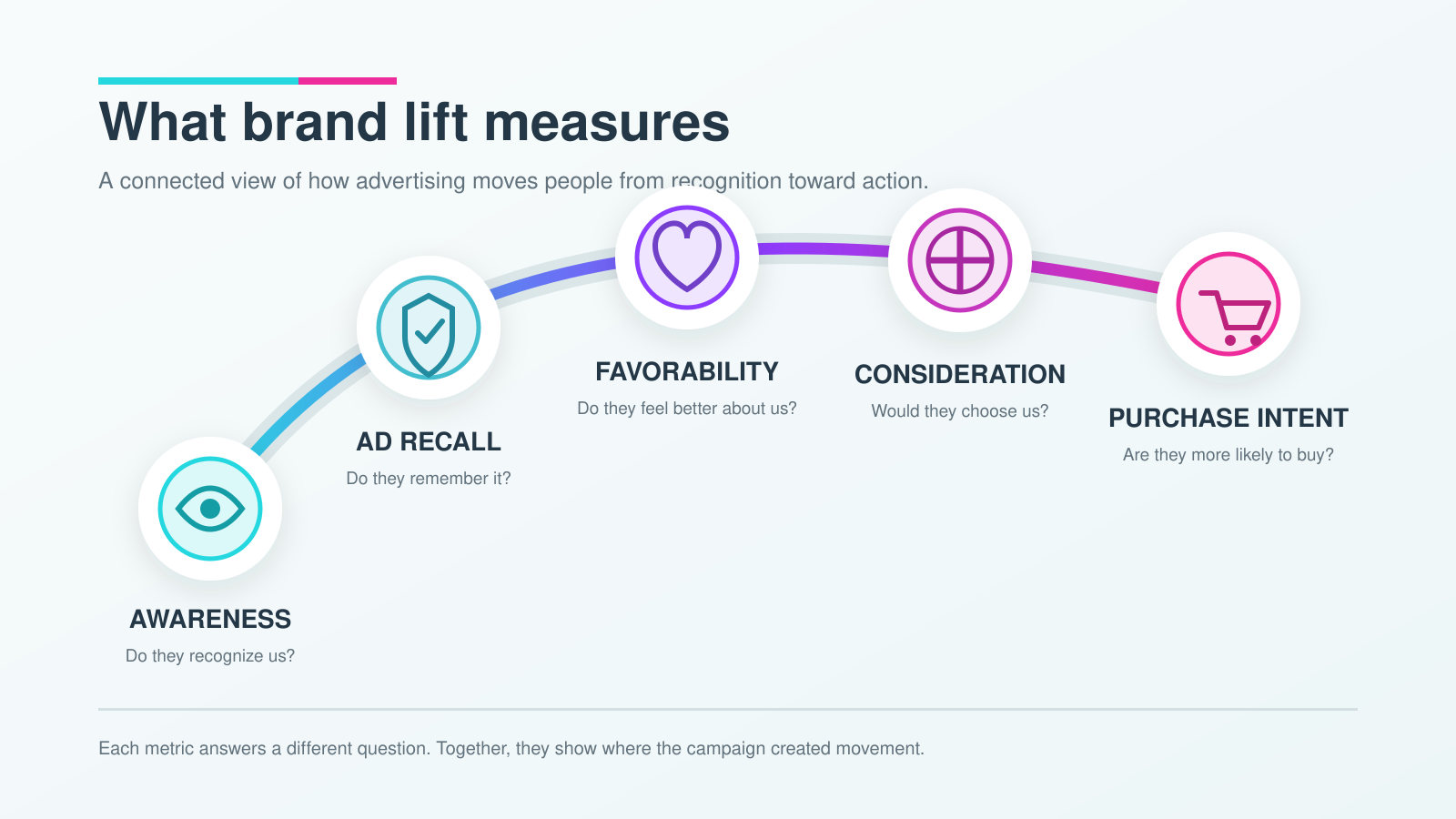
Common brand lift metrics include:
- Brand awareness: Whether more people recognize the brand after campaign exposure
- Ad recall: Whether audiences remember seeing the advertising and connect it to the correct brand
- Brand favorability: Whether exposure improves how positively people view the brand
- Consideration: Whether people become more likely to consider the brand
- Purchase intent: Whether exposure increases the likelihood of a future purchase
- Message association: Whether audiences connect the intended message or attribute with the brand
Why brand lift matters
Performance metrics are essential, but they do not tell the entire story. A campaign can generate reach without creating recall. It can drive clicks without strengthening preference. It can also build meaningful brand value that is not immediately visible in conversion data.
Brand lift measurement helps marketing teams:
- Evaluate awareness investment beyond impressions and reach
- Identify which creative ideas generate the strongest recall and response
- Compare results across audiences, formats and channels
- Recognize gaps between awareness, favorability and consideration
- Build internal benchmarks that make future campaigns more informed
- Give leadership a clearer view of how brand investment contributes to growth
Brand lift is most valuable when it informs a decision, not when it becomes another number in a reporting deck.
How a brand lift study works
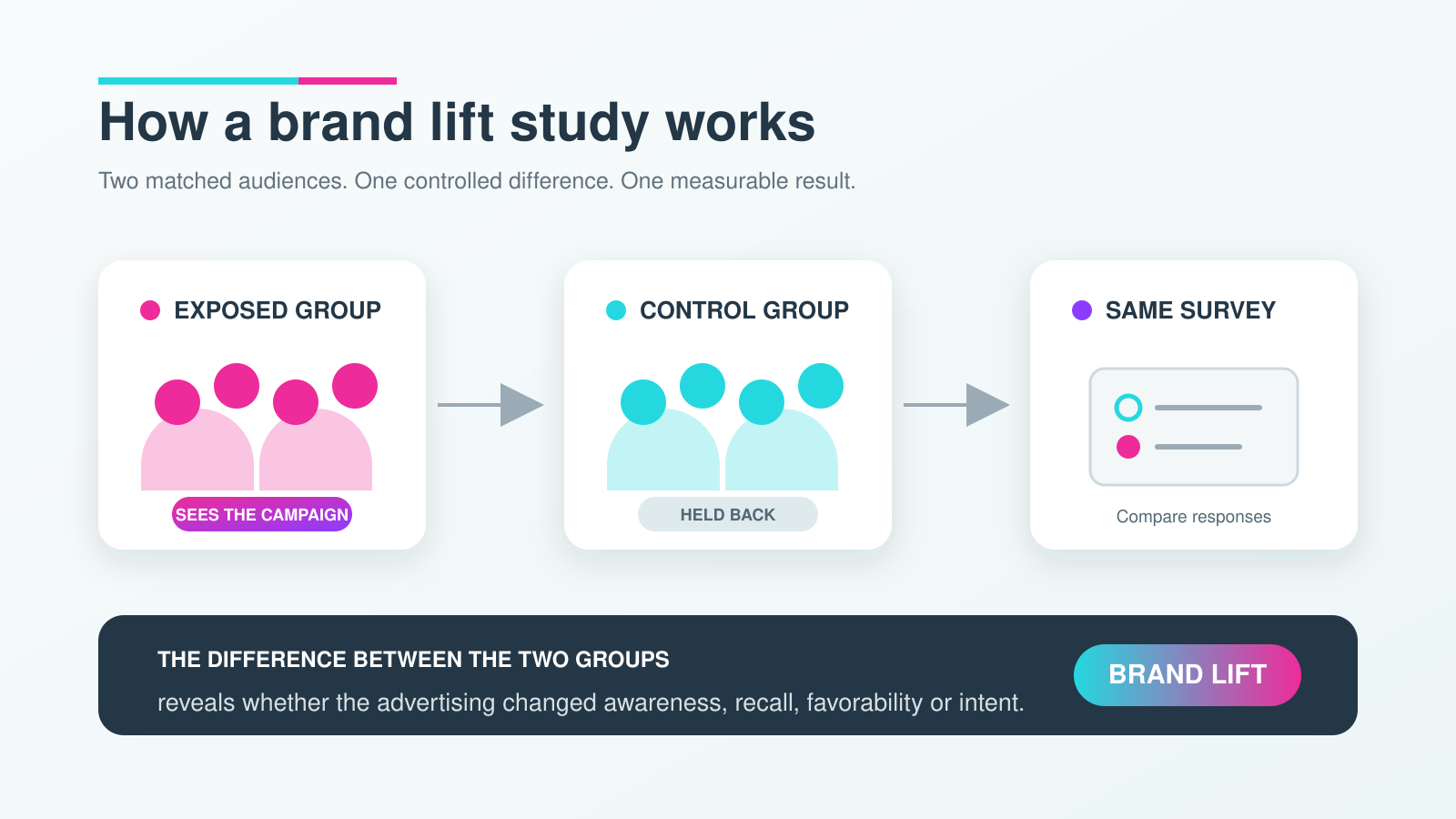
At its simplest, a brand lift study compares two carefully constructed groups:
- Exposed group: People who had an opportunity to see the campaign
- Control group: Similar people who were intentionally held back from seeing it
Both groups answer the same survey questions. Researchers then compare the responses to determine whether exposure produced a measurable difference. Platform-based programs such as Google Ads Brand Lift can create the groups and deliver surveys within their own advertising environments. Independent research providers can measure broader campaigns that cross multiple channels.
The methodology matters. Audience selection, sample size, survey wording, campaign reach and confidence levels all influence whether the results are reliable enough to guide decisions.
What the metrics actually tell you
Awareness and familiarity
Awareness reveals whether people recognize the brand. Familiarity goes a step further by asking whether they feel they know enough about the company, product or service to understand what it offers.
Ad recall
Ad recall measures whether audiences remember the advertising itself. Strong recall can signal that the creative idea, brand cues and message worked together effectively. High recall without clear brand association, however, may mean the advertising was memorable but the brand was not.
Favorability and consideration
Favorability measures sentiment. Consideration measures whether someone would include the brand among the options they might choose. A campaign can improve awareness without improving either of these metrics, which is why they should be evaluated separately.
Purchase intent
Purchase intent indicates whether exposed audiences report being more likely to buy. It is closer to a commercial outcome, but it remains a stated intention rather than an observed sale. It should be considered alongside conversion and revenue data.
How brand lift data improves marketing decisions
The value of a brand lift study comes from connecting its findings to specific choices.
- Creative development: Compare concepts, messages and formats to understand which ideas build recall, favorability or consideration.
- Media allocation: Evaluate where campaign exposure appears to create meaningful brand movement, not simply inexpensive impressions.
- Audience strategy: Examine results by audience segment to identify where the campaign is resonating and where it is not.
- Frequency planning: Study the relationship between exposure frequency and response to find the point at which additional impressions stop adding value.
- Budget conversations: Give marketing and finance teams evidence that connects upper-funnel investment with shifts in audience perception.
One important caution: Do not focus only on the headline lift number. Review the confidence level, sample size and range of possible results. A dramatic-looking percentage is not necessarily meaningful if the study was too small or the result is not statistically reliable.
How to design a useful brand lift study
- Define the decision you need to make. Start with the business question, then select the metric. Do not measure everything simply because the survey allows it.
- Choose a clear primary objective. Decide whether the campaign is primarily intended to build awareness, recall, favorability, consideration or intent.
- Protect the control group. Accidental exposure can weaken the comparison and understate the campaign's effect.
- Use neutral survey language. Questions should avoid leading respondents toward a positive or negative answer.
- Plan for an adequate sample. Smaller expected changes generally require larger samples to measure confidently.
- Allow enough time and reach. The campaign needs sufficient exposure and the study needs enough responses before conclusions can be drawn.
- Choose the right measurement partner. Platform studies can work well for campaigns concentrated within one advertising ecosystem. Independent partners may be more appropriate for campaigns spanning multiple channels.
Creative clarity is part of the measurement strategy
Measurement cannot rescue an unclear idea. If a campaign tries to communicate too many messages, the results may show weak recall or association even when the media plan delivers strong reach.
At Spin Creative, we see clarity as a performance advantage. The strongest brand work is not always the work with the highest production budget or the most complicated execution. It is the work built around a focused idea, expressed in a way the audience can understand and remember.
That is where creative strategy and brand lift measurement reinforce each other. The strategy defines the response the campaign is intended to create. The creative gives the audience something distinctive to hold onto. The study reveals whether that connection happened.
When insight-driven brand storytelling is paired with disciplined measurement, marketing teams can move beyond assumptions and make better decisions about what to build next.
Key takeaways
- A brand lift study compares exposed and control groups to isolate the effect of advertising.
- Awareness, recall, favorability, consideration and purchase intent measure different stages of audience response.
- Study design, sample size and confidence levels determine whether the findings are actionable.
- Results become valuable when they influence creative, audience, media and budget decisions.
- Clear creative gives audiences something specific to remember and gives measurement a focused outcome to evaluate.
Ready to build campaigns that move brand metrics, not just impressions?
Spin Creative partners with enterprise marketing teams to develop brand-led creative that is built to perform and built to be measured.