Rebrand Strategy: A Practical Guide for Marketing Leaders
A successful rebrand starts with strategy, not a new logo. When a brand no longer reflects the business behind it, the effects can show up everywhere: confused buyers, inconsistent messaging, slower sales conversations, difficulty entering new markets, and creative work that never quite connects. But that does not always mean the answer is a complete rebrand.

Sometimes the business needs a new position and identity. Sometimes it needs to preserve what people already recognize while modernizing how the brand is expressed. And sometimes the real problem is not the brand at all.
Before anyone opens a design file, marketing and brand leaders need to answer a more fundamental question:
What business problem are we asking the brand to solve?
That answer should determine the scope, strategy, creative direction, and rollout plan that follow.
Start with a brand diagnostic
A rebrand should be driven by evidence of commercial friction, not internal fatigue with the current identity.
Begin by asking:
- Is the current brand creating measurable friction in sales, recruitment, or market entry?
- Has the business materially changed its audience, category, offering, or value proposition?
- Does the current brand misrepresent the organization the company has become?
- Are customers describing the business differently from the way the company describes itself?
- Is there evidence from customer research, win-loss analysis, or performance data that brand perception is contributing to the problem?
If several of these are true, a broader rebrand may be warranted. If the strategy remains relevant but the execution feels dated or inconsistent, a focused refresh may be enough.
The goal of the diagnostic is to separate what is actually broken from what is simply familiar.
A useful diagnostic should produce:
- A clear view of which brand assets still create recognition
- A map of where the current positioning diverges from customer expectations
- An understanding of how competitors occupy the category
- A prioritized list of business and brand problems to solve
- A recommendation for the appropriate level of change
One of the most expensive mistakes in a rebrand is discarding a color, phrase, symbol, or visual behavior that customers already associate with the company. Familiarity can feel stale internally long before it loses value externally.
Should you refresh, partially rebrand, or start over?
Not every brand problem requires the same response.
Visual refresh
A visual refresh updates the expression of the brand without changing its underlying strategic foundation.
This might include:
- Refining the logo system
- Modernizing color and typography
- Updating photography or illustration
- Creating more consistent digital and motion behaviors
- Improving accessibility and usability
- Strengthening brand guidelines
A refresh is usually the right choice when the company’s audience, value proposition, and position remain relevant, but the visual system no longer feels distinctive, flexible, or current.
Partial rebrand
A partial rebrand changes meaningful parts of the strategy and identity while preserving valuable brand equity.
This approach may include:
- Refining or changing the positioning
- Expanding the audience definition
- Rebuilding the messaging architecture
- Evolving the logo rather than replacing it
- Introducing a more complete design and motion system
- Reframing the company’s role within its category
This can be appropriate when a company is entering a new market, integrating an acquisition, expanding its offering, or moving toward a different kind of customer.
Full rebrand
In a full rebrand, nearly everything can be reconsidered: name, positioning, messaging, identity, voice, and go-to-market narrative.
That level of change may be necessary when:
- The business model has fundamentally changed
- The existing name or identity creates reputational problems
- The company has entered an entirely different category
- The current brand actively limits growth
- Multiple organizations are combining into a new entity
A full rebrand can create powerful momentum, but it also brings the greatest cost, complexity, and risk.
The best approach is usually the smallest level of change capable of solving the documented business problem.

Audit the brand before defining the future
A brand audit is not a creative review of what people like and dislike. It is an evidence-gathering process designed to reveal what the market recognizes, what customers value, and where the current story is falling short.
A useful audit typically includes several inputs.
Customer conversations
Interviews with a focused group of customers can reveal:
- The language customers use to describe the company
- Why they initially considered the brand
- What created confidence during the buying process
- What they see as meaningfully different
- Which claims feel credible and which do not
- Where the experience fails to match the promise
Six to ten thoughtful conversations with the right customers often produce more useful strategic insight than a broad survey filled with generic responses.
Internal stakeholder interviews
Leadership, sales, product, customer success, and recruiting teams experience different parts of the brand.
These conversations help uncover where the brand creates friction internally and externally. They also reveal conflicting interpretations of the company’s value that the strategy will need to resolve.
Competitive analysis
Review the positioning, claims, proof points, visual territory, and content behaviors of the company’s most relevant competitors.
The purpose is not to imitate what the category is doing. It is to understand which ideas have become interchangeable and where the brand has an opportunity to stand apart credibly.
Performance data
Depending on the organization, the audit may also examine:
- Website engagement and conversion
- Organic and paid search performance
- Brand awareness and consideration
- Share of voice
- Win/loss findings
- Customer acquisition cost
- Sales-cycle length
- Net Promoter Score and customer satisfaction trends
- Recruiting and retention data
The audit should conclude with a concise set of findings and implications, not an overwhelming inventory of everything the company has ever produced.
Lock the positioning before design begins
Research provides the inputs. Strategy determines what to do with them.
Before creative exploration begins, leadership should align on three things:
- Who the brand is for
- What the brand wants to be known for
- Why customers should believe it
A useful positioning statement clarifies the audience, category, primary benefit, and most credible reason to choose the brand.
One familiar structure is:
For [specific audience], [brand] is the [category or frame of reference] that [primary benefit] because [supporting proof].
The final external language may be more expressive, but the underlying strategic statement should remain simple enough to guide real decisions.
Test the positioning against a few basic questions:
- Can someone understand it after one read?
- Does it identify a meaningful audience?
- Does it make a choice rather than trying to appeal to everyone?
- Can the organization support the claim with evidence?
- Does it connect to an outcome customers actually value?
- Can sales, product, and creative teams all use it?
If the positioning is still open to interpretation, the design brief is not ready.
Build a messaging architecture
The positioning should lead to a clear hierarchy of messages.
Primary claim
What is the single most important idea the audience should understand?
This should be specific enough to differentiate the company and broad enough to support its major offerings.
Supporting messages
Identify three to five ideas that make the primary claim credible. Each should connect to something the organization can demonstrate, such as:
- A product capability
- A proprietary process
- A customer result
- A distinctive operating model
- Deep category experience
- A meaningful point of view
Proof
Determine how each message will be substantiated through customer stories, data, demonstrations, thought leadership, or specific examples.
The strongest brand messages do not stop at sounding good. They create a structure that the company can repeatedly prove.
Define what the new identity needs to do
The identity should make the strategy visible, memorable, and usable.
That can include:
- Logo and identity system
- Color and typography
- Graphic language
- Photography and illustration
- Iconography and data visualization
- Brand voice
- Motion principles
- Sound and music
- Digital design behaviors
- Brand film and video
- Guidelines and templates
Not every element should change just because it can.
A practical way to evaluate an existing asset is to consider two factors:
Recognition: Do customers already associate this element with the company?
Strategic fit: Does it support the position the company wants to occupy next?
That produces four possible actions:
- High recognition and high strategic fit: preserve it
- High recognition and low strategic fit: evolve it carefully
- Low recognition and high strategic fit: strengthen it
- Low recognition and low strategic fit: replace it
This keeps the identity process focused on building future relevance without unnecessarily destroying existing equity.
Design for movement, not just appearance
Brands rarely live as static identity boards anymore.
They move across product experiences, video, social content, sales presentations, event screens, digital advertising, customer stories, and internal communications.
That means a contemporary identity needs more than a logo, color palette, and typography system. It needs behaviors.
How does the brand reveal information?
How does it transition from one idea to another?
How do its shapes, typography, images, and sounds behave over time?
How does it create recognition when the logo is not present?
Motion can transform a collection of visual assets into a coherent brand experience. When developed alongside the identity rather than added later, it gives the brand a more distinctive and consistent way to communicate across channels.
Planning the rollout
A rebrand can affect dozens of touchpoints, from a company’s homepage and product interface to its email signatures, pitch decks, signage, contracts, and recruiting materials.
The launch plan needs the same discipline as the strategy and creative work.
A useful priority structure is:
Priority 0: Legal and operational requirements
- Trademark review
- Entity names and filings
- Contracts
- Domains
- Compliance materials
- Vendor and partner requirements
Priority 1: Core digital experiences
- Website
- Product experience
- Email signatures
- Social profiles
- Customer communications
- Company presentations
Priority 2: Sales and marketing
- Pitch decks
- One-pagers
- Case studies
- Campaign creative
- Videos
- Event materials
- Recruiting content
Priority 3: Physical and partner materials
- Signage
- Packaging
- Printed collateral
- Swag
- Partner materials
- Environmental applications
Every touchpoint should have a named owner, delivery date, approval path, and status.
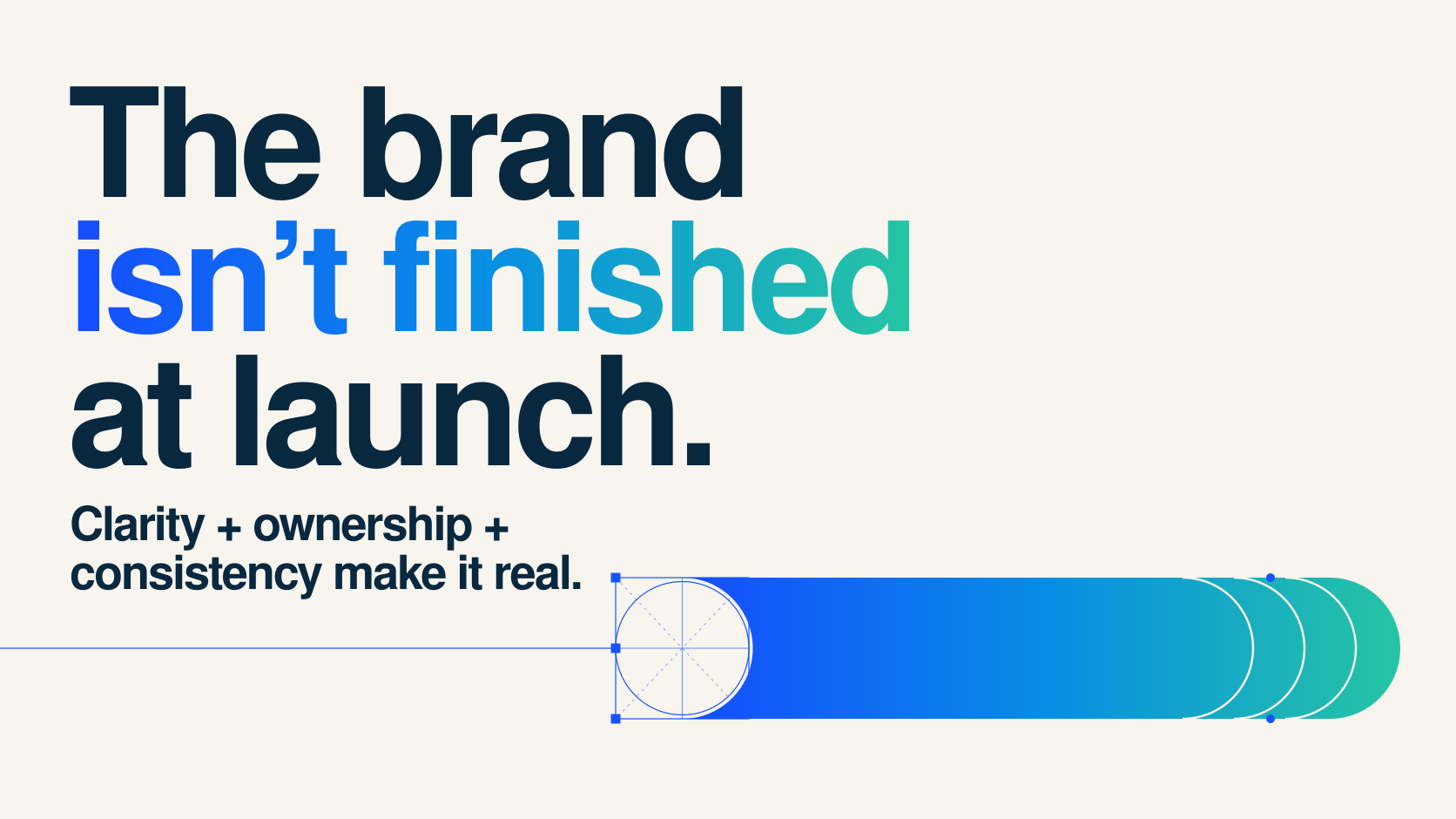
Without that ownership, old assets quickly return, different teams build their own interpretations, and the new brand starts fragmenting almost immediately.
Phased rollout or single launch?
A single coordinated launch creates a clear market moment, but it also requires nearly every high-priority touchpoint to be ready at the same time.
A phased rollout introduces the brand in stages. A typical sequence might be:
- Internal launch and training
- Core website and digital channels
- Sales and marketing materials
- Physical and partner-facing touchpoints
- Lower-priority legacy materials
For many organizations, a phased rollout is more practical. It reduces operational risk and gives teams time to absorb the new strategy.
The risk is a period of mixed-brand visibility, so the sequence and transition need to be clearly communicated.
Whichever model is selected, the internal launch should come first. Employees, especially sales and customer-facing teams, need to understand what is changing, why it is changing, and how to communicate the new story before the public sees it.
Measure business impact, not aesthetic approval
A rebrand should not be judged primarily by whether internal teams like the new design.
Success should connect back to the business conditions that prompted the work.
Depending on the objective, measurement may include:
- Unaided brand awareness
- Brand consideration
- Website conversion
- Organic and paid traffic quality
- Customer acquisition cost
- Sales-cycle length
- Pipeline velocity
- Average deal size
- Recruiting performance
- Customer or employee sentiment
Document the baseline before launch so the organization has something meaningful to compare against.
The first 90 days should also include operational measures:
- Are old assets still appearing?
- Are teams using the correct templates?
- Is the new messaging being applied consistently?
- What questions are sales teams hearing?
- Are customers understanding the new position?
- Which channels need additional guidance or refinement?
If a metric declines, avoid immediately changing the creative system. First identify whether the issue is strategic, operational, channel-specific, or simply a measurement inconsistency.
Common rebrand mistakes
Most rebrands do not struggle because the creative team failed to produce an attractive identity. They struggle because the organization made the wrong decisions before or after the design work.
Treating a rebrand as a design project
When positioning is unresolved, design presentations become expensive strategy meetings. The work is evaluated against personal preference because there is no agreed strategic standard.
Changing too much
A desire to make the launch feel dramatic can lead teams to discard recognizable and useful brand assets. More change does not automatically create more impact.
Trying to speak to everyone
A broad audience definition creates broad messaging and generic creative. A more specific understanding of the best-fit customer usually produces a more resonant brand.
Compressing strategy to protect the timeline
When speed matters, simplify the scope or phase the rollout. Do not remove the research and positioning work that every later decision depends upon.
Launching before the organization is ready
If the website is new but the sales deck, customer emails, and employee language are not, the market experiences several versions of the company at once.
Failing to assign ownership
Brand guidelines alone will not maintain consistency. Teams need clear access to assets, usable templates, established approval paths, and named owners.
How Spin Creative approaches rebranding
At Spin, we see a rebrand as an integrated strategy, identity, and communications program.
Our process typically moves through five connected phases.
1. Discovery
We begin with stakeholder conversations, available research, performance data, competitive context, and a clear definition of the business problem.
The output is a focused brief and recommendation for the appropriate scope.
2. Strategy
We define or refine the audience, positioning, brand personality, messaging architecture, and creative criteria.
This creates the strategic foundation that leadership and creative teams can use to make decisions throughout the engagement.
3. Identity
We translate the strategy into a distinctive visual, verbal, and motion system designed to work across the brand’s most important channels.
Depending on the assignment, that may include visual identity, messaging, brand film, motion principles, campaign expression, digital design, and brand guidelines.
4. Rollout
We help prioritize the highest-impact touchpoints, build the assets teams need, and create a rollout system that can be implemented consistently.
5. Activation and evolution
A brand becomes meaningful through use. We support the campaigns, content, films, and experiences that introduce the new position and keep building recognition over time.
Spin works as a tight senior team from brief through delivery. Strategy and creative stay connected throughout the process, without handing the work off to layers of junior teams after kickoff.
The real determinant of rebrand success
The creative work matters enormously. But the quality of that work depends on the clarity of the decisions behind it.
A successful rebrand has:
- A documented business reason for change
- A level of scope appropriate to the problem
- Research grounded in actual customer experience
- Clear positioning and messaging
- An identity system built for real-world use
- Operational ownership across every major touchpoint
- A plan for measuring impact after launch
The question is not simply, “What should the new brand look like?”
It is, “What does the business need the brand to make possible?”
When that answer is clear, the strategy becomes sharper, the creative becomes more distinctive, and the rollout becomes far easier to defend.
If your organization is weighing a refresh, repositioning, or complete rebrand, connect with Spin Creative to define the right scope and next step.
About Spin Creative
Spin Creative is an independent creative agency helping ambitious brands turn complex business ideas into clear, compelling brand experiences. Our tight senior team connects strategy, branding, advertising, design, motion, and video from brief through delivery, without layers of handoffs.