How We Brought Yext's "Be the Answer" to Life: Motion for the Age of AI Search
Search has changed. People no longer type keywords, they ask real questions, and they expect a real answer. A brand film is one of the most powerful ways for a company to show it understands that shift.
Key takeaways
- AI search has moved buyers from keywords to conversational questions, and brands now get discovered through answers, not just links.
- A hero brand film is one of the fastest ways to show the market a company understands that shift and can solve for it.
- For complex or technical products, motion design can explain a process and build understanding faster than voiceover or copy.
- We built the Yext film around a simple structure, Ask, Assemble, Answer, that mirrors how AI search actually works.
- A film built as a motion system, not a one-off, can scale across formats, channels, and languages without losing polish.
Yext Be the Answer Brand Film
When Yext set out to reintroduce itself as an AI-forward search visibility platform, they partnered with Spin Creative to bring their new "Be the Answer" brand film to life. The 90-second hero film had a clear job: establish Yext as a foundational leader in AI-driven search, and set the motion language for the product films that would follow.
Rather than lay graphics over stock footage, we approached the film as a single motion system, where every beat is built to carry the story.
Here's how we approached the project and the creative principles that shaped the final result.
What Is a Hero Brand Film?
A hero brand film is a short, high-impact video that introduces a company's positioning to the market and anchors the campaign that follows.
Unlike a product demo or an explainer, a hero film is focused on perception. Its purpose is to create momentum, establish emotional resonance, and signal that something meaningful has changed.
For enterprise brands, hero films often become cornerstone assets used across websites, events, sales, social channels, and entire campaign ecosystems. Done well, a single film can set the tone for a year of marketing.
What Is AI Search, and Why Does It Change Brand Strategy?
AI search is the shift from keyword queries and blue links to conversational questions answered by AI tools and assistants like ChatGPT, Perplexity, and Google's AI Overviews.
Instead of scanning a results page, people now ask something specific and get a single synthesized answer. That answer is assembled from many sources at once: reviews, listings, maps, and websites.
The strategic consequence is significant. Brands are increasingly discovered inside the answer rather than on a results page, which is why marketers are now thinking about answer engine optimization (AEO) and generative engine optimization (GEO), the practice of making sure your brand is accurate, consistent, and surfaced when AI assembles a response. Yext's entire pitch lives in this shift, and the film had to make that shift feel real.
Our Creative Strategy: Motion as the Message
The central creative conviction behind the Yext film was simple.
AI is easy to make cold. Our job was to keep it human.
Most films about data and AI reach for the same visual shorthand. Glowing grids. Neon. Sci-fi futurism. That language signals technology, but it creates distance, and distance is the opposite of what a search company wants its customers to feel.
So every motion decision we made pulled in the other direction. Toward warmth. Toward clarity. Toward the pace of a real person living a real moment.
We treated motion as the argument itself, not decoration on top of it. The timing, the transitions, and the rhythm were the tools we used to make an invisible data process feel intuitive, calm, and human.
Why We Chose Restraint Over Spectacle
The strongest films about complex technology show less, not more.
A platform like Yext does an enormous amount beneath the surface, and the instinct is to put every capability on screen. But a brand film succeeds through focus, not volume.
Our approach was to reduce rather than explain. We chose a small number of carefully built moments designed to create understanding and curiosity, and we let motion do the heavy lifting so the viewer never has to work for the idea.
A hero film isn't a feature list. It's an invitation to believe the company can solve a real problem.
The "Ask, Assemble, Answer" Framework
We built the film around a simple three-part structure that mirrors how AI search actually works. It doubles as a useful way to think about telling any AI or data story on screen.
Ask: Start with the human, not the technology
Open on the real questions people ask. A parent searching for urgent care. Friends choosing where to eat. A traveler checking in with a dog in tow. Against each moment, clean glass interface elements float into frame, timed so the technology feels like a quiet assistant rather than the star of the scene.
The principle: before any data appears, the viewer should see themselves. Lead with the human need and the product earns its place.
Assemble: Let motion reveal the process
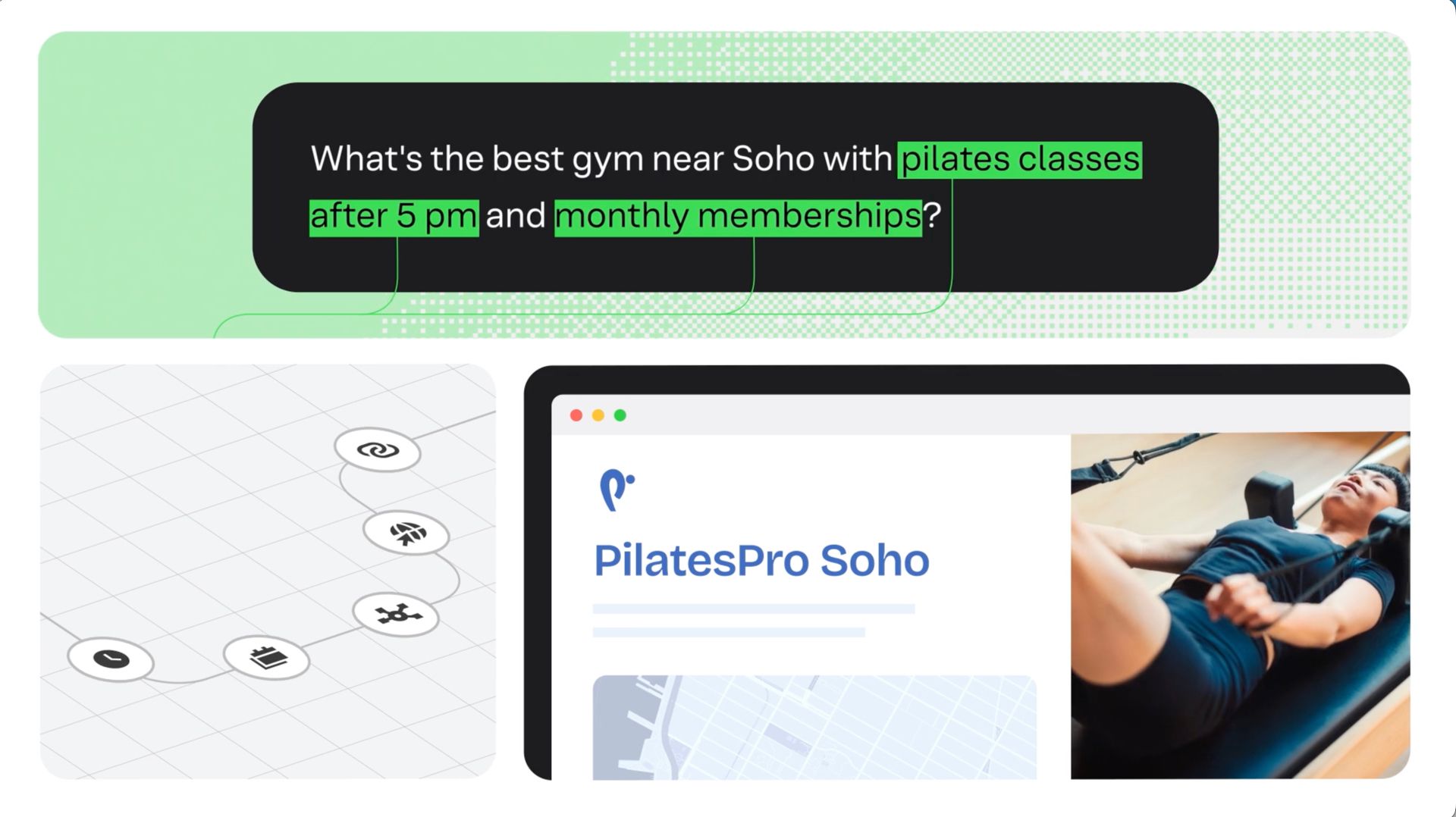
The center of the film is its analytical heart. We take a single dense, real-world question and animate it breaking into its working parts. Reviews. Location. Products and services.
The principle: when a process is hard to explain in words, show it moving. Choreographed as a light, precise data layer, the sequence reads as intelligence at work without tipping into cliche, and a complex idea lands in seconds.
Answer: Resolve to a clear payoff
The film scales outward into a stylized Knowledge Graph that connects sources across the web back to a single question, then brings Yext's Scout dashboard and its visibility scoring to life through clean glass panels in motion.
The principle: every data story needs a moment of resolution. The film lands where it began, on a real person getting a precise, tailored answer, before settling on the brand promise: Be the Answer.
Why Motion Does the Explaining
Motion design can teach a process faster than voiceover or copy, which is why it works so well for abstract products.
Explaining how AI assembles an answer usually requires narration packed with jargon. We wanted the opposite. We wanted the movement to carry the meaning, so the idea lands without anyone having to spell it out.
When animation is built to reveal something step by step, viewers don't just watch the content. They understand it. That is the difference between motion as decoration and motion as a system. One looks nice. The other does a job.
Building a Film That Travels
A hero film is only as valuable as the system underneath it, and this one was built to keep working long after launch.
The motion language carried forward into a full UK English edition and localized German, French, and Italian versions for Yext's international markets.
That is harder than it sounds. Languages expand and contract against English, which ripples through every on-screen query box, interface element, and highlighted word across deeply layered files. To keep the voiceover locked to the existing animation, we produced the foreign-language reads in house, controlling timing and preserving the feel of the original performance. Captions were built by hand for each language, because accuracy at this level is not something to hand to an automated tool.
Rather than treat each market as a quick swap, we approached every version as an extension of the same motion system. The result was one master story engineered to move cleanly across four markets without losing a frame of polish.
What Makes a Great Brand Film for the AI Era?
A great brand film for the AI era names a real problem, makes the solution feel human, and leaves the audience wanting to learn more.
It doesn't try to explain everything. It communicates confidence and clarity, and it earns trust before it asks for attention.
For Yext, that meant taking a genuine modern anxiety, the fear of being invisible in an AI-driven search landscape, and answering it with calm. The film positions Yext as the control center for brand data by making the viewer feel understood first and informed second.
Frequently Asked Questions
What is a brand film?
A brand film is a short-form video that introduces a company's positioning, identity, or strategic direction to its audience and creates emotional resonance around it. It focuses on perception and momentum rather than features.
What is AI search?
AI search is the use of AI tools and assistants, such as ChatGPT, Perplexity, and Google's AI Overviews, to answer conversational questions with a single synthesized response drawn from many sources at once, rather than returning a list of links.
How do brands show up in AI search?
Brands appear in AI search when their information is accurate, structured, and consistent across the web, so AI can confidently pull it into an answer. This practice is often called answer engine optimization (AEO) or generative engine optimization (GEO), and it is the core problem platforms like Yext are built to solve.
Why use motion design for a complex product story?
Motion can reveal a process, show relationships, and build understanding in ways static design and dense copy cannot. For abstract or technical products, it turns an explanation into an experience the viewer feels rather than decodes.
How long should a brand film be?
Most effective hero films range from 60 to 90 seconds, depending on the audience and where the film will live, with shorter cutdowns created for social and paid channels.
About Spin
Spin Creative is a brand storytelling agency specializing in branding, design, motion, and advertising. We help enterprise and growth-stage brands create scalable creative ecosystems that move audiences and build demand.
If you are rethinking how your brand shows up in the age of AI search, or you have a story that deserves to move, say hello. We would love to help bring it to life.